

Columbus
Columbus P-9 Race Precision GNSS Receiver for Professional Racing (25Hz Update Rate, Meter-Level Accuracy, Dual-Mode Bluetooth)
Columbus P-9 Race Precision GNSS Receiver for Professional Racing (25Hz Update Rate, Meter-Level Accuracy, Dual-Mode Bluetooth)
Country of Origin: China
Couldn't load pickup availability

The Columbus P-9 Race is built for applications that need both speed and meter-level accuracy. With an industry-leading 25 Hz update rate, it delivers ultra-fast position updates for racing, UAVs, aviation, and other dynamic tracking work.
Horizontal positioning reaches 0.7 m CEP (50%) and 2.0 m CEP (95%). Wired USB and dual-mode Bluetooth keep it compatible with common operating systems—so you get high-speed updates without giving up usable accuracy.
25 Hz update rate · 0.7 m CEP (50%) · Dual-mode Bluetooth · USB + BLE + SPP · u-blox M9N · IP67 antenna
Key Features

25 Hz Update Rate
- Lightning-fast position updates at 25 Hz
- Built for real-time tracking and high-speed motion
→ Capture dense position data when every tenth of a second counts

Meter-Level Accuracy
- 0.7 m CEP (50%)
- 2.0 m CEP (95%)
→ High update rate without sacrificing usable horizontal accuracy

Low Latency
- Update interval as low as 0.04 s
- Faster response for dynamic motion analysis
→ Instant position refresh for racing and UAV workflows

Four Concurrent Constellations
- GPS · Galileo · GLONASS · BeiDou
- More satellites for better signal selection and filtering
→ Stronger sky coverage for high-rate positioning

High-Gain External Antenna
- Large external high-gain active antenna
- Designed for strong, stable reception at 25 Hz
→ Antenna performance matched to ultra-high update rates

IP67 Antenna Protection
- Industrial-grade IP67 external antenna
- Built for outdoor, all-weather mounting
→ Rugged antenna for track, field, and vehicle installs

Wired & Wireless Connectivity
- USB serial plus dual-mode Bluetooth
- Compatible with common desktop and mobile OS platforms
→ Connect phones, tablets, and PCs without a single-path lock-in

NMEA 0183 Output
- Standard NMEA 0183 sentences
- Works with a wide range of GNSS apps and tools
→ Drop into common racing, mapping, and navigation software
Part Description

How P-9 Race Delivers Fast, Accurate Positioning
Two hardware foundations: a concurrent multi-constellation GNSS engine and a large high-gain active antenna.
1. Latest u-blox GNSS Module — 4 Concurrent Constellations
The P-9 Race uses the u-blox M9N, a 92-channel GNSS engine with strong sensitivity and fast acquisition across L1 GNSS systems. Concurrent reception from GPS, Galileo, GLONASS, and BeiDou increases the number of visible satellites so the receiver can select stronger signals and improve position accuracy.
Advanced filtering helps mitigate RF interference and jamming, allowing the P-9 Race to sustain high accuracy together with a high update rate.

2. High-Gain Active Antenna with 4 Feed Points
Antenna size and design are critical to 25 Hz performance. The P-9 Race antenna measures 60 × 60 mm including the protection shell, with a 48 × 48 mm reception area—about 3.6× larger than a typical 25 × 25 mm patch. It uses four feed points instead of one, with stronger gain and bandwidth for stable reception at ultra-high update rates.

Why High Update Rate Matters
The same kart-track segment recorded at 1 Hz, 5 Hz, and 25 Hz shows how update rate changes track detail.
1 Hz

1 Hz diagram
Only a few scattered points—the track is effectively indistinguishable.
5 Hz

5 Hz diagram
A recognizable path appears, but detail is still limited for high-speed analysis.
25 Hz

25 Hz diagram
A smooth, dense track with enough detail for accurate high-speed analysis—ideal for racing and similar dynamic applications.
Side-by-Side Track Comparison
Tests used a kart track rather than a full-size race circuit—smaller layout, higher G-load, and sharper direction changes create a more demanding environment.

1. Single-Lap Test
- Laps: 1 · Elapsed: 43″ · Mileage: 437 m
- Average speed: 36.6 km/h · Max speed: 46 km/h · Max acceleration: 1.3 G
- Focus: Consistency with the actual track
- Time: UTC 2023-02-01 07:14:10 – 07:14:53
- Download the track (KMZ)
Regular GNSS receiver

P-9 Race

2. Multiple-Laps Test
- Laps: 11 · Elapsed: 7′52″ · Mileage: 4,702 m
- Average speed: 35.9 km/h · Max speed: 46 km/h · Max acceleration: 1.4 G
- Focus: Multi-lap consistency
- Time: UTC 2023-02-01 07:14:10 – 07:22:02
- Download the track (KMZ)
Regular GNSS receiver

P-9 Race

Operating System Compatibility
The P-9 Race works with Windows, macOS, Android, Linux, iOS, and iPadOS—covering laptops, tablets, smartphones, and other compatible devices.

Important for iOS / iPadOS: Check the P-9 Race iOS compatible app list before purchase. If your app is not listed, the P-9 Race will not work with that iOS or iPadOS app.
Simultaneous Device Connections
The P-9 Race provides three output interfaces: 1 × Bluetooth SPP, 1 × Bluetooth BLE, and 1 × USB serial / COM port. Using all three at once, up to three devices can receive GNSS data simultaneously—for example one phone over Bluetooth SPP and one laptop over USB.

Bluetooth
Built-in dual-mode Bluetooth supports BLE 5.1 and SPP 2.1. For a strong, stable link, plan on a reliable working range of about 10 m (33 ft) or slightly beyond.

Technical Specifications
Protection & Environment
| External Active Antenna | IP67 |
| Main Unit | Not waterproof |
| Operating Temperature | -20 °C to 50 °C / -4 °F to 122 °F |
GNSS Performance
| Module | u-blox M9N · 92 channels |
| Signals | GPS L1C/A · Galileo E1-B/C · GLONASS L1OF · BeiDou B1I · QZSS L1C/A · SBAS (EGNOS, GAGAN, MSAS, WAAS, QZSS L1S) |
Positioning Ability*
| Reacquisition | < 2 s |
| Hot Start | < 2 s |
| Cold Start | < 29 s |
| Horizontal Accuracy | 0.7 m CEP (50%) · 2.0 m CEP (95%) |
| Note | * Supports “EPS Race” technology · 25 Hz mode · Ideal open-sky test conditions |
Output & Update Rate
| Protocol | NMEA 0183 |
| Default Messages | GNRMC, GNGGA, GNGSV, GNGSA |
| Geodesics | WGS84 |
| Update Rate | 25 Hz (default) |
Bluetooth
| Modes | SPP 2.1 · BLE 5.1 |
| Reliable Range | Up to slightly > 10 m (33 ft) |
Connectors & Power
| USB | USB 2.0 Type-A |
| Antenna Connector | SMA |
| Antenna Cable | 300 cm / 9.8 ft |
| P-9 Race Power | DC 5 V / 70 mA |
| External Antenna Power | DC 3.3 V / 35 mA |
System Requirements
| Windows | Windows 7 or later |
| macOS | Mac OS X v10.10 or later |
| Linux | Kernel 2.6.12 or later |
| iOS / iPadOS | 15 or later |
| Android | Android 10 or later |
Certificates
| Compliance | FCC · CE · RoHS |
Size and Weight


What's in the Box
- P-9 Race Professional Racing GNSS Receiver
- External Active Antenna
- Warranty Card
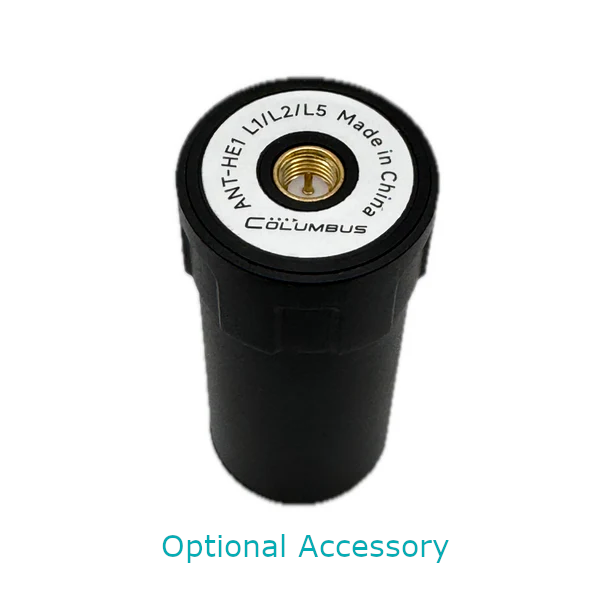
- Helical Antenna Kit (Optional)
Use P-9 Race on iPhone & iPad
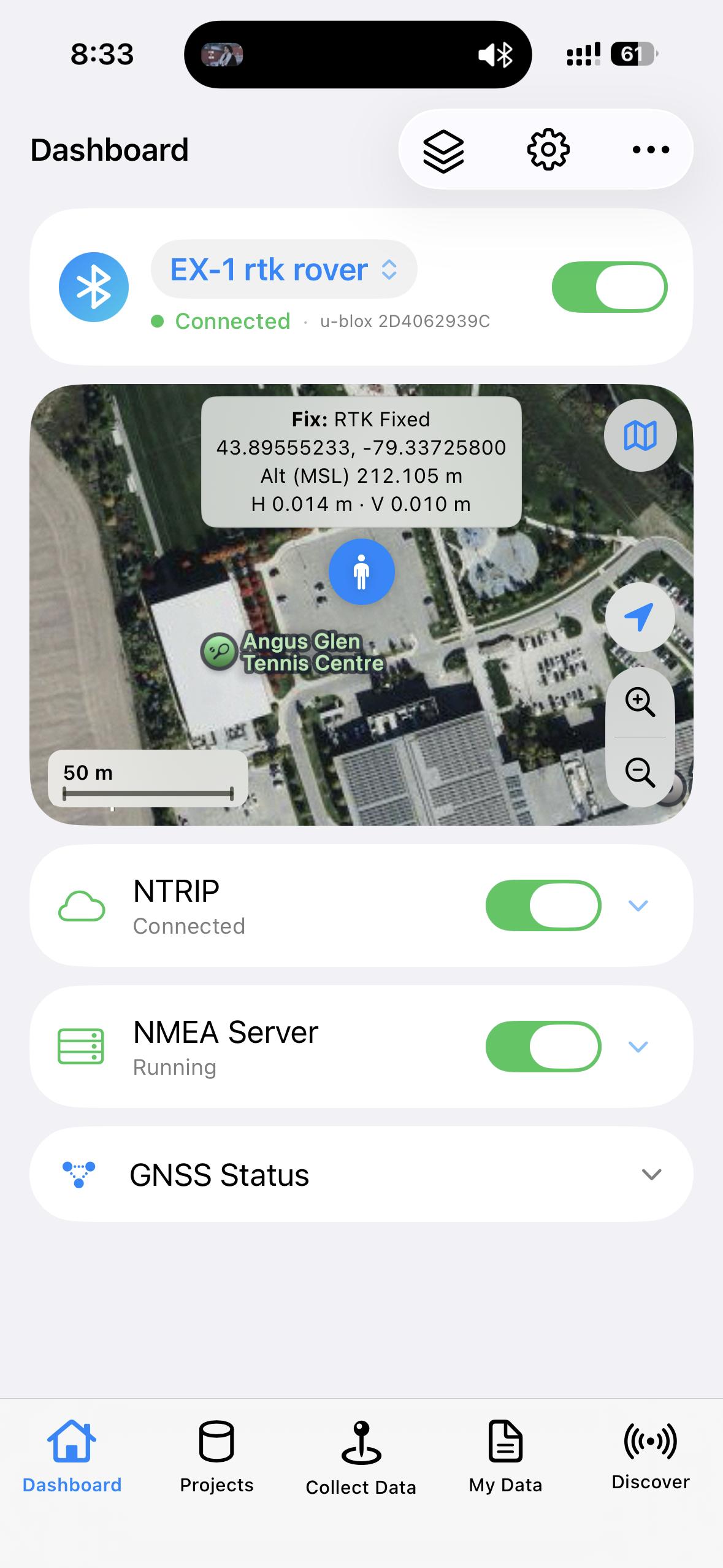
Pair the Columbus P-9 Race with the free GeoAstra BLE-GNSS iOS app to stream receiver positions, share NMEA with other apps on the same device, and collect field data from iPhone or iPad.
GeoAstra BLE-GNSS is the software bridge that brings a compatible BLE GNSS receiver—such as P-9 Race—onto iOS. Positions shown and recorded in the app come from the connected receiver, not from the built-in iPhone/iPad GPS.

High-Rate GNSS on iOS
Connect P-9 Race over Bluetooth and bring 25 Hz receiver positions onto iPhone or iPad for dynamic tracking workflows.
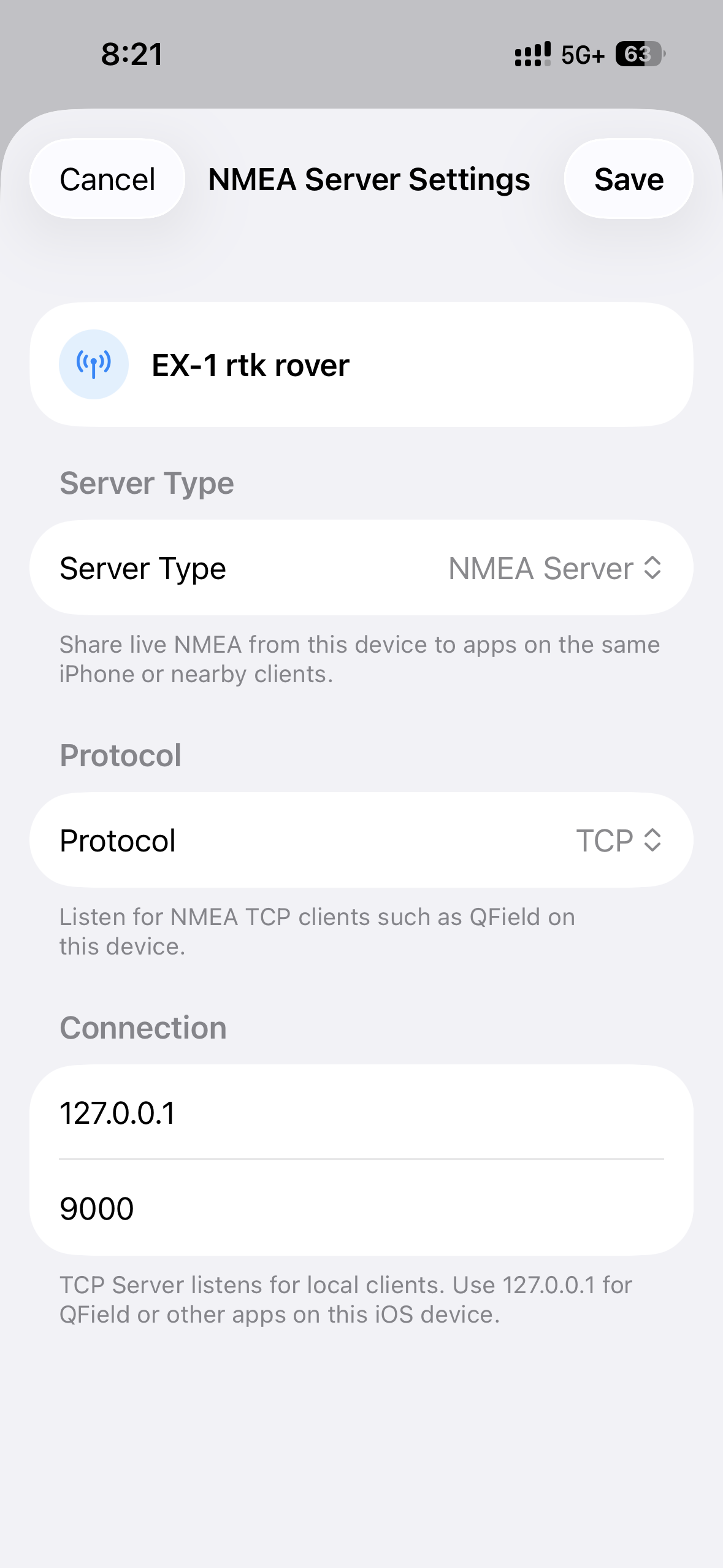
Local NMEA Server
Share the receiver’s NMEA stream with other iOS apps that support TCP/UDP NMEA clients—on the same device.
Collect, Stakeout & Export
Use the app’s projects, points, tracks, stakeout and export tools when you want a complete workflow without a third-party field app.
Want the full feature list, compatible-receiver notes and setup details? See the GeoAstra BLE-GNSS iOS App product page.
Product Resources
Official Documents


Downloads
Driver Downloads
-
 USB GNSS driver — built into Windows OS, no download needed
-
GNSS Sensor Device driver for Windows 10 / 11
-
 USB GNSS driver — built into macOS, no download needed
-
 USB GNSS driver — built into Linux OS, no download needed
Tool Downloads
How-to Articles and Blogs
-
 How to view the positioning information output by P-9 Race?
-
How to connect a GPS/GNSS Receiver to Google Earth on Windows?
-
How to connect a GNSS Receiver to Windows Maps (or Windows Location Service)?
-
How to test the positioning accuracy of the P-9 Race?
-
Why Can’t You Rely on Accuracy Readings from Some GPS/GNSS Apps for Advanced GNSS Receivers Like the Columbus P9 Race?
Tech Support Topics and Forums
-
 Is it possible for the main unit of the P-9 Race to function without being connected to the antenna?
-
What is the baud rate for output from the P-9 Race?
-
When the P-9 Race outputs location data, is it referring to the position of the antenna or the main unit?
-
How to view the positioning information output by P-9 Race?